Your Custom Text Here

Yoga Pose Asana CloudC Yoga Yoga Pose Asana CloudC Yoga

FOUR Yoga Poses to Relieve Neck and Shoulder Pain

Tightness in the neck and shoulders can often result in pain in these areas. Managing neck and shoulder pain is simpler than it may seem. All it takes is 15-20 minutes of mindful stretching and breathing exercises each day. By peeling away the layers of tension in our muscles, we can return to a peaceful state. This straightforward routine can be easily incorporated into our daily lives, giving you the confidence to take control of your pain management.
Tightness in the neck and shoulders can often result in pain in these areas. For many people, lifestyle is the main contributing factor, such as working at a desk for long periods, engaging in laborious work over the long term, or maintaining unhealthy postures.

Another one is the psychological factor when one is often under stress, tension, anxiety and depression. These negative emotions are said to store tension around our neck and shoulders as well.

Managing neck and shoulder pain is simpler than it may seem. All it takes is 15-20 minutes of mindful stretching and breathing exercises each day. By peeling away the layers of tension in our muscles, we can return to a peaceful state. This straightforward routine can be easily incorporated into daily life.

About This Yoga Sequence

  • Level: Beginner to Intermediate

  • Sessions per week: 2-3 times per week

  • Time of day: Anytime during the day for relaxation, with the best times being in the afternoon or evening.

  • Types of exercises: Pain Management, Beginner Yoga, Simple Stretching

  • Tools needed: One yoga strap or towel, one yoga block or thick book.


    Note that your safety is our priority. If you have a long-term illness, stress, or uncertain conditions, please consult a doctor or professional before attempting to any practices.


YouTube Practice on Neck and Shoulder Stretch


Four Yoga Poses for Neck and Shoulder Stretch to Relieve Pain

The following introduces the benefits of four yoga stretches, including Cat-Cow Pose, Cow Face Pose, Side Neck Stretch, and Puppy Pose. These poses can help relieve shoulder and neck pain caused by muscle tightness. Practice the pose on our YouTube video for neck and shoulder stretch.

Pose 1: Cat-Cow Pose (Viralasana) | Benefits for Spinal Health

Cat Cow (Viralasana) is a typical pose for most practice. It’s a foundational yet powerful yoga pose for spinal health. The movement in the pose opens the space between each vertebral joint, promoting greater mobility of the spine from the neck to the lower back. The movement also stretches the muscles around the spine. Synchronise the movement with the rhythm of the breath to promote deeper concentration and relaxation of the mind and body.


Pose 2: Cow Face Pose (Gomukhasana) | Benefits for Shoulders and Deltoid Muscles

This sequence focuses on the upper body. Cow Face Pose (Gomukhasana) is an excellent yoga pose for dynamically stretching the muscles around the shoulders, especially effective in releasing tension in the deltoid muscles. If you spend much time working at your desk, consider incorporating this beneficial pose into your daily routine.


Pose 3: Side Neck Stretch | Benefits for Neck

Our necks are designed to move in a wide range of motion, from front to back, left to right, and rotation. Side neck stretching is simple and does not have many alignment restrictions. Consider adding this pose to your office yoga routine.


Pose 4: Puppy Pose (Uttana Shishosana) | Benefits for Spine and Shoulders

Puppy Pose helps to fully extend the spine and stretch the shoulders. Regular practice can help restore a healthy spinal curve and open the chest, countering the effects of hunching. It also stretches and opens the shoulders, which benefits those with tight shoulders.


Conclusion

Incorporating a regular yoga practice into your routine can significantly help alleviate neck and shoulder pain caused by muscle tightness, stress, and poor posture. By dedicating just 15-20 minutes each day to mindful stretching and breathing exercises, you can gradually release tension and return to a state of peace and relaxation.

With dedication and consistency, you can take control of your pain management and work towards a healthier, more comfortable lifestyle. Keep up the practice.


Read More
Yoga Pose Asana CloudC Yoga Yoga Pose Asana CloudC Yoga

Wheel Pose (Urdhva Dhanurasana): Restore spinal curve and help with Hunchback

Explore the benefits and techniques of Wheel Pose (Urdhva Dhanurasana) with our comprehensive guide. Learn proper alignment, safety precautions, and how to experience the incredible yoga pose.

Wheel Pose, also called Urdhva Dhanurasana in Sanskrit, is an excellent backbend that engages every muscle in the body. It opens the front of the body while strengthening the back body.

This article will cover this beautiful yoga pose's essential preparation steps, alignment, safety, and benefits.


Preparation: Get your body ready for Wheel Pose (Urdhva Dhanurasana)

  • Proper Warm-Up: Before attempting the Wheel Pose, warm up your body with full-body opening practice. It's always best to include several rounds of Sun Salutation and another warm-up sequence focusing on the spine, shoulders, and hips. Think of it as awakening your muscles and preparing them for this dynamic posture.

  • Building Strength and Flexibility: A strong foundation is critical. Strengthen your back, shoulders, and core with exercises like Cobra Pose (Bhujangasana), Plank Pose, and Bridge Pose (Setu Bandhasana). These poses will help you build the strength and flexibility you need for Wheel Pose.


Steps: Getting into Wheel Pose (Urdhva Dhanurasana)

Lift Your Hips: Press through your feet and lift your hips up to create an arch with your back.

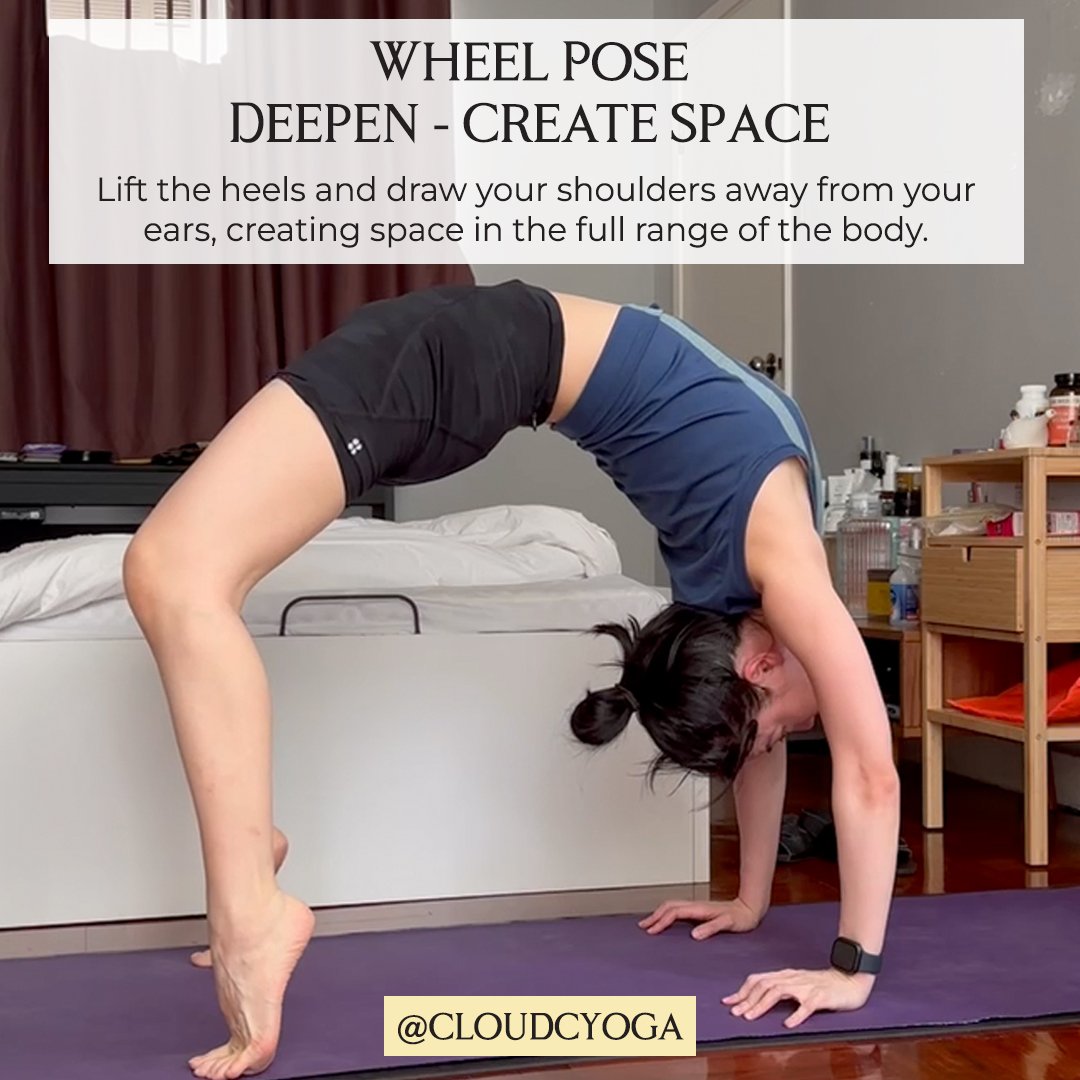
Deepen with Heels Up: Lift the heels and draw your shoulders away from your ears, creating space in the full range of your the body.

  1. Start on Your Back: Lie on your back on the floor. Bend your knees and bring your heels to your buttocks, feet hip-width apart. Place your hands under your shoulders, palms down.  

  2. Lift Your Hips: Press through your feet and lift your hips up to create an arch with your back.

  3. Half Wheel Pose: Rest the top of the head on the floor; for beginners, consider staying at the Half Wheel Pose as a light version of the Wheel Pose. (See Image or Click HERE)

  4. Straighten Your Arms: Slowly straighten your arms, pushing through your palms to lift your chest up and open your chest.

  5. Creating More Space: To deepen the pose, lift the heels and draw your shoulders away from your ears, creating space in the full range of the body. (See Imageor Click HERE)


General Alignments: Practice Wheel Pose Safely (Urdhva Dhanurasana)

  1. Hands Position: Place your hands under your shoulders, fingers pointing towards your shoulders, and ensure your palms are flat and have a firm grip on the yoga mat.

  2. Chest Opening: While holding the Pose, allow your chest to open and lift.

  3. Spinal Curve: As you lift into Wheel Pose, allow your spine to gently open and explore your natural curve. Do not overly arch your back.

  4. Strong Legs: Engage your quads, hamstrings and hips to support the Pose.

  5. Neck Relaxed: Keep your neck long and relaxed.

  6. Shoulder Space: Draw your shoulders away from your ears to prevent strain on your neck and shoulders.


Safety: Listen to your body

  • Do not force yourself, especially your lower back. It's common to feel pain and strain in Wheel Pose when the body is NOT open correctly or in proper alignment. Pay attention to the important message that your body is sending you.

  • Practice Patience: Building strength and flexibility in every yoga pose takes time, and the wheel pose is like no other. Take your time to understand the Pose and practice regularly to equip yourself with the strength and flexibility you need for this Pose.


General Benefits of Practising Wheel Pose

  1. Release Shoulder Tightness and Hunchback: Wheel Pose focuses on opening the upper body and building strength for the entire spine. By alleviating tension in the back, it also provides an opportunity for individuals with hunchbacks to restore a healthy curvature of the spine.

  2. Breathe Better: Regular backend practice, such as wheel pose, may improve shortness of breath as it opens more space in the upper body, especially the chest and ribcage.

  3. Healthy Spinal Curve: Proper backbend practice, such as Wheel Pose, is beneficial for neutralising the spinal curve and restoring balance to a hunched spine, a common condition of modern sedentary lifestyles.

  4. Enhance Strength: Wheel Pose strengthens the muscles in your back, shoulders, and legs.

  5. Better Circulation and Energy: Yoga backbends, such as Wheel Pose, can boost blood flow to the brain, improving circulation.

  6. Enhance Focus and Concentration: As you must be fully present when attempting this muscular Pose, your concentration level will be cultivated over time.


Read More
Yoga Pose Asana CloudC Yoga Yoga Pose Asana CloudC Yoga

Headstand (Sirsasana): The Alignments and Benefits

Unlock the power of the Headstand (Sirsasana) with our detailed guide. Learn proper alignment and safety tips, and discover the benefits of this transformative yoga pose.

The headstand, or Sirsasana, is a powerful yoga pose with numerous bodily and mental benefits. It's known to strengthen your core, improve circulation, boost energy levels, calm the mind, and even enhance your sense of balance and focus. However, this inversion requires careful alignment and preparation to avoid injury.

This guide will help you understand the key elements of practising a safe and effective headstand.


Preparation, Before You Begin

With a mindful approach, we can create a safe and fulfilling headstand practice. Let's begin by preparing our bodies with a warm-up, strengthening our core, and always seeking guidance when needed.

  • Warm-Up: Always warm up your body before attempting a headstand. Do a full-body warm-up, focusing more on your neck, shoulders, and spine.

  • Build Strength: Strengthen your upper body and core with exercises like planks, push-ups, and shoulder stands. These will create a strong foundation for your practice.

  • Seek Guidance: If you're new to inversions or have any injuries, consult a qualified yoga teacher or healthcare professional before practising headstands. Their expertise will guide you safely on your journey.


Alignment, The Key to Safety and Grace

Alignment is a way of listening to and honoring our body's wisdom. By aligning our body in headstand, we create a safe and balanced experience that allows us to fully experience the benefits of this powerful inversion.

  1. Head Placement:

    • Interlace your fingers, forming a triangle with your palms.

    • Place the top of your head on the floor, ensuring your elbows are shoulder-width apart. Forming a solid foundation

  2. Arm and Shoulder Engagement:

    • Keep your arms firm and engaged, as if you're pushing the floor away with strength.

    • Your shoulders should be away from your ears, creating space and ease within your arm and shoulder areas.

  3. Core:

  4. Leg Placement:

    • Start with your legs bent, feeling the earth beneath your feet.

    • With gentle intention, lift one leg, then the other.

    • Keep your legs together, engage your thighs and quadriceps.

  5. Gaze:

    • Rest your gaze slightly beyond, embracing a sense of calm and centeredness.


Safety, Honoring Your Body

Safety and mindfulness go hand in hand in our yoga journey. Let's approach headstand with care, honoring our bodies' needs and finding balance through gentle guidance and a supportive environment.

  • Wall Support: A wall can offer comforting support for those starting their journey. Use it to build confidence and find your balance.

  • Listen to Your Body's Wisdom: Gently release the pose if you feel any discomfort. Your body is always telling you something.

  • Embrace Gradual Progress: Let us begin with shorter holds, gradually increasing the duration as your strength and confidence grow. Be patient with yourself.

  • Breathe as Our Anchor: Breathe deeply and evenly throughout the pose. Each inhale and exhale anchors us to the present moment, allowing us to find peace and balance.


Benefits, The Power of Headstand

Headstand is a practice that unlocks a world of potential within us. Let's explore the incredible ways this powerful pose can enhance our strength, flexibility, and sense of well-being.

  • Increased Strength and Flexibility: Headstands challenge your core, arms, and shoulders, building strength and enhancing flexibility.

  • Improved Circulation and Energy: Inversions like headstands increase blood flow to the brain, improving circulation and boosting energy levels. Feel that energy flowing through you!

  • Calming the Mind: The headstand can help calm the nervous system and promote relaxation.

  • Enhanced Focus and Concentration: The increased blood flow to the brain can sharpen focus and improve concentration.

Remember that the headstand is a path to building strength, grace, and self-discovery. Approach each stage with patience, love, and a focus on safety. Namaste.


Read More
Yoga Pose Asana CloudC Yoga Yoga Pose Asana CloudC Yoga

Downward Facing Dog: Essential Yoga Posture and Beginner Modifications for Maximum Benefits

Downward Facing Dog and 2 Variations for Beginners" is a helpful guide for those new to yoga. The article introduces the classic Downward Facing Dog pose and provides two variations tailored specifically for beginners. Whether you're looking to improve flexibility, build strength, or simply relax, this guide offers a great starting point for your yoga journey.

Downward Facing Dog: Essential Yoga Posture

The yoga posture known as Downward Facing Dog (Adho Mukha Svanasana) is familiar to all. Whether or not you engage in yoga, you have likely come across this pose at some point.

Now, let us examine it more closely and delve into the two modifications designed for beginners to enhance this essential yoga posture's mental and physical advantages.


Downward Facing Dog Version 1: The Original Version

Downward Facing Dog

To get into a downward-facing dog, starting from the tabletop pose is commonly recommended,

  1. From the tabletop, lift the knees up off the floor.

  2. Through that, extend to find the entire length of the spine. A downward-facing dog's most important aspect is finding the full release of the spine to get the most benefits.

  3. Keep your head down, pointing downward.

  4. The legs could be straightened or bent if the spine is adequately elongated without rounding.

  5. For beginners, stay in the pose for 2-3 breaths and gradually build up to a longer duration.

The downward-facing dog can be modified for individuals with different ranges of motion, especially those with less mobility training. Below are the most recommended modifications for entry-level beginners or anyone who finds it hard to accommodate into the full version yet,


Option 2. Modification Bend Knees Version Downward Facing Dog

Downward Facing Dog easy version

Based on the steps from the original version, slightly bend your knees towards your chest while maintaining the spine in proper alignment without rounding.  

Stay in this pose for around 3-5 long deep breaths.


Option 3.  Modification with movement - Paddling in Downward Dog

Based on option 1, paddling your feet in and out in the downward dog. 

Start slightly bending your right knee towards your chest while straightening your left leg. Feel the left leg stretch from the calf muscles to the hamstring and hips. Repeat the same motions on the other side. 

For active practice, keep your paddling lightly and smoothly; at any point, if you feel a deeper stretch and connection on one of the legs, you may stay there longer. 

Downward Facing Dog modification
Downward Facing Dog paddling

What are the benefits of a downward-facing dog? 

The Light of Yoga by B.K.S. Iyengar emphasizes the numerous benefits of incorporating downward-facing dogs into one's yoga practice. Here's a concise summary in bullet points.

  • When one is exhausted, staying longer in this pose removes fatigue and brings back the lost energy. 

  • The pose is perfect for runners who get tired after a hard race.

  • The pose relieves pain and stiffness in the heels and helps to soften calcaneal spurs. It strengthens the ankles and makes the legs shapely. 

  • This asana helps eradicate stiffness in the region of the shoulder blades, thereby relieving arthritis of the shoulder joints. 

  • The abdominal muscles are drawn towards the spine and strengthened. The heart rate is slowed as the diaphragm is lifted to the chest cavity. 

  • Those afraid to do Siraasana (headstand) can conveniently practise this position. As the trunk is lowered in this asana, it is fully stretched, and healthy blood is brought to this region without any strain on the heart.


Read More
Yoga Pose Asana CloudC Yoga Yoga Pose Asana CloudC Yoga

Learn the Modified Sun Salutation Sequence for Beginners

Sun Salutation is a must-learn sequence for beginners in yoga. However, it can be challenging for many students to master the sequence due to its complexity. As a yoga teacher, I have modified the sequence over the years to help my students gradually build the strength and mobility required for their long-term yoga journey. In this article, I will guide you through the modified version of the Sun Salutation sequence with step-by-step instructions, enabling you to lay a solid foundation for your future success. Remember to breathe deeply and move along with the rhythm of your breath to enjoy the beauty of Sun Salutation.

Sun Salutation is the must-to-learn when introducing yoga to beginners. Interestingly, throughout my years of teaching, the Sun Salutation sequence has been more challenging than it seems to most beginners. 

Many of my students were frustrated when they first learned the Sun Salutation; hence, I modified it so they could eventually taste the sequence's beauty and build up the strength and mobility required for their long-term journey. 

Sun Salutation varies slightly between different yoga styles and traditions, but whatever version you aim for, this modification will lay a solid foundation for your future success.


  1. Start from standing in Tadasana and rebuild the intention of standing firmly grounded. 

  2. Keep your feet shoulder distance, and feel the power of grounding while standing. 


Step 2 - Arms Extended in Mountain Pose (Utthita Hastasana in Tadasana)

002. Sun Salutation - Arms Extended in Mountain Pose - Utthita Hastasana in Tadasana

Arms Extended in Mountain Pose (Utthita Hastasana in Tadasana)

  1. Raise your arms next to your ears.

  2. Chest slightly lifted, gaze upward. 

  3. Enjoy deep breaths in this gentle front body opening. 


  1. Dive into a standing forward bend with your knees bent.

  2. Grab your ankle with your hands. 

  3. Bring the belly close to the thighs as much as possible.

  4. Elongate the spine.

  5. Keep neck and head relaxed. 


Step 4: Half Forward Bend (Ardha Uttanasana)

Half Forward Bend - Ardha Uttanasana 

Half Forward Bend - Ardha Uttanasana 

  1. Lift head halfway. 

  2. Elongate the spine.

  3. Keep knees slightly bent at a comfortable level. 


Step 5: Low Lunge (Anjaneyasana)

Low Lunge (Anjaneyasana)

Low Lunge (Anjaneyasana)

  1. Step your right leg back, and bring your knee to the floor.

  2. Arms reach up next to the ears.

  3. Keep the foundation solid, and remain steady in the pose.


Step 6: Cat Cow (Marjaryasana)

  1. On inhalation, drop the belly and head up. 

  2. On exhalation, round the back chin of the chest.

  3. Exploring the space within your space.

  4. Move along with the rhythm of your breath. 

Cat Cow (Marjaryasana)

Cat Cow (Marjaryasana) - Cow Pose

Cat Cow (Marjaryasana)

Cat Cow (Marjaryasana) - Cat Pose


Step 7:  Downward-Facing Dog - Adho Mukha Svanasana

Downward-Facing Dog - Adho Mukha Svanasana

Downward-Facing Dog - Adho Mukha Svanasana

  1. From the Table Pose (the set-up of Cat-Cow), tuck your toes under and extend the back leg up. 

  2. Spread the fingers wide with a firm grip on the floor. 

  3. Extend the spine long, and the buttocks lift. 

  4. Keep the spine long and straight, and bend your knee to adjust the spine's elongation.


Step 8: Three-Legged Dog - (Tri Pada Adho Mukha Svanasana)

Three-Legged Dog - (Tri Pada Adho Mukha Svanasana)

Three-Legged Dog - (Tri Pada Adho Mukha Svanasana)

  1. From Downward Facing Dog in Step 7, bring the feet together. Knees can remain bent. 

  2. Extend the right leg up without putting pressure on the upper body. 


Step 9: Low Lunge (Anjaneyasana)

Low Lunge (Anjaneyasana)

  1. From Three-Legged Dog in Step 8, step the right foot forward between the palm.

  2. The body comes all the way up with arms reached up.

  3. Maintain the pose.


Step 10. Half Forward Bend - Ardha Uttanasana 

Half Forward Bend - Ardha Uttanasana

Half Forward Bend - Ardha Uttanasana

  1. From Step 9, step the left foot forward into a standing forward bend.

  2. Lift head halfway. 

  3. Elongate the spine.

  4. Keep knees slightly bent at a comfortable level. 


  1. Dive into a standing forward bend with your knees bent.

  2. Grab your ankle with your hands. 

  3. Bring the belly close to the thighs as much as possible.

  4. Elongate the spine.

  5. Keep neck and head relaxed. 


Step 12. Arms Extended in Mountain Pose (Utthita Hastasana in Tadasana)

Arms Extended in Mountain Pose (Utthita Hastasana in Tadasana)

Arms Extended in Mountain Pose (Utthita Hastasana in Tadasana)

  1. Slowly coming up to a standing pose.

  2. Reach arms up, chest slightly lifted. 


Step 13: The Prayer Pose (Pranamasana)

The Prayer Pose (Pranamasana)

The Prayer Pose (Pranamasana)

  1. Bring Palms together into prayer, taking a moment to centre the mind and body. 

  2. Keep breathing slowly and gently. 


Step 14: Back to Mountain Pose

  1. Return to mountain pose and feel the breath and circulation running inside the body. 

  2. Stay a moment of peace. 

  3. Repeat Steps 1-12, but start by stepping the left leg back this round. 

Conclusion

In conclusion, Sun Salutation is a fundamental sequence in yoga that helps build strength, flexibility, and mindfulness. It may seem challenging at first, but with consistent practice and modifications, beginners can eventually master it and enjoy its beauty. Remember to breathe deeply and move along with the rhythm of your breath.

More Yoga Blogs

Read More
Yoga Pose Asana CloudC Yoga Yoga Pose Asana CloudC Yoga

5 Best Yoga Poses To Do During Period - Yoga for Women

If you're struggling with menstrual pain and discomfort, these 5 gentle yoga poses are perfect for you. Designed specifically for heavy blood flow days, this article provides a detailed breakdown of each pose and a video tutorial to help you perform them safely and correctly. With regular practice, these poses can help you feel more relaxed and comfortable during your menstrual cycle. So don't wait, try them out today and experience the benefits for yourself!

Yoga Sequence for a Restful Period - Yoga for Women

One of the five tips we mentioned in our previous article on yoga for menstruation is to keep the sequence comforting and intentionally gentle. This week, let's dive into one of our yoga sequences for menstruation on YouTube. 

As always, I hope my yoga content helps you navigate the ups and downs of life, allowing you to savour each moment with abundant health, wealth, and happiness. 

The five yoga poses sequenced below are designed for a restful period, especially during heavy blood flow days when you are physically tight, exhausted, and fatigued. This sequence is intended to be soothing, relaxing, and gentle. You do not need to explore the deepest level of your range of motion; instead, stay where it makes you feel good and at ease. 

Please note that this sequence is designed with the most minor support of your yoga tools. You may need more tools to support you if some part of your body is feeling pressured. 

If you need more clarification about your yoga practice, I have a solution for you - a Free 60-minute Yoga Consultation. The first session is Free for everyone! Just click the button below to claim your Free consultation.


Yoga Pose 1: Reclined Butterfly Pose (Supta Baddha Konasana)

To Set the Pose: Lying down on the floor, a block or pillow for head and neck support is optional. 

Reclined Butterfly Pose (Supta Baddha Konasana)

  • Start by resting your head comfortably on the block or pillow. 

  • Bend your knees in an external rotation, with the soles of the feet touching one another. 

  • You can set the heels further away or closer depending on how comfortable you feel.

  • Do not attempt this pose if there's pressure on the knees. 

  • Seek professional advice for modifications if needed. 


Yoga Pose 2: Happy Baby Pose (Ananda Balasana)

To Set the Pose: Lying down on the floor, a block or pillow for head and neck support is optional.

Happy Baby Pose (Ananda Balasana)

  • From lying down, bend both of your knees towards your chest. 

  • Spread the knee and feet slightly wider than the torso.

  • Palms reach out to grab the outer or inner edge of your feet.

  • Do not attempt this pose if there are pressures on the knees. 

  • Seek professional advice for modifications if needed. 


Yoga Pose 3: Reclined Big Toe Pose B (Supta Padangusthasana B)

To Set the Pose: Lying down on the floor, it is recommended that a yoga strap be used to assist.

Reclined Big Toe Pose B (Supta Padangusthasana B)

  • From lying down, wrap the strap around your left foot.

  • Extend your left leg to the left side. Hold the strap comfortably while maintaining both hips and shoulders evenly on the floor. 

  • Feel the gentle stretch on your left leg.

  • Stay in the pose for 2-3 minutes with gentle, steady breathing. 

  • Change to the right leg afterwards.


Yoga Pose 4: Supine One Knee to Chest / Half Wind Release Pose (Ardha Pavan Muktasanaa)

To Set the Pose: Lying down on the floor, a block or pillow for head and neck support is optional. 

Supine One Knee to Chest / Half Wind Release Pose (Ardha Pavan Muktasanaa)

  • From lying down, bend the right leg and hug the knee to chest.

  • Holding the leg from the front of the calf muscles.

  • Feel the gentle release from the hip.

  • Stay in the pose for 2-3 minutes with gentle, steady breathing. 

  • Change to the left leg afterwards, and stay with an equal amount of time. 


Yoga Pose 5: Supine Spinal Twist Pose (Supta Matsyendrasana)

To Set the Pose: Lying down on the floor, a block or pillow for head and neck support is optional. 

  • From lying down, hug both knees to chest.

  • Drop both legs to the left side and feel the gentle release from the waist.

  • To progress further, turn the head to the right side. 

  • Stay in the pose for 2-3 minutes with gentle, steady breathing. 

  • Switch sides and stay for an equal amount of time. 

Supine Spinal Twist Pose (Supta Matsyendrasana)

Supine Spinal Twist Pose (Supta Matsyendrasana)


Conclusion

In conclusion, these five yoga poses can help you feel more relaxed and at ease during your period, especially on heavy flow days when you may feel physically exhausted and tight. Remember to listen to your body and only go as far as it feels comfortable for you. And if you need additional support or advice, don't hesitate to seek professional guidance. With regular practice, yoga can be a powerful tool for managing menstrual discomfort and promoting overall health and well-being. So go ahead, give these poses a try and see how they work for you!


Read More
Yoga Pose Asana CloudC Yoga Yoga Pose Asana CloudC Yoga

Five Yoga Poses for Tight Hips

We all encounter the discomfort of tight hips at times. Luckily, yoga is here to help us out. Yoga improves our overall body mobility and helps release tightness in our hips. Let’s dive into the five poses in this article.

Five Yoga Poses for Tight Hips for Greater Mobility, One Free Video Tutorial Included

We all encounter the discomfort of tight hips at times. Luckily, yoga is here to help us out. Yoga improves our overall body mobility and helps release tightness in our hips. I've included five recommended yoga poses and One Tutorial on YouTube for free in this article. Read until the end for the free video tutorial.

As always, seek professional guidance for the best results. You can either book a class with us or practice under the guidance of your trusted yoga teacher!


Five Yoga Poses for Tight Hips

Yoga Pose One - Light and Gentle Hip Movement


To Set the Pose: Sitting at the centre of the yoga mat.

  • Bend your knees and place your palms around one to two palms away from your hip. 

  • Drop your knees left and right while turning your head in the opposite direction. 

  • Practice for around 5 to 10 rounds with steady breathing.

Gentle Movement for tight hips 1

Gentle Movement for tight hips

Gentle Movement for tight hips 1

Gentle Movement for tight hips


Yoga Pose Two - Seated Hip Opener

Seated Hip Opener for Tight Hips

To Set the Pose: Sitting on the floor or elevating your seat on the towel or block.

  • Bend the left leg and grab the outer part of your left foot.

  • Set your left knee just below your armpit.

  • Hold the Pose for around 3 - 5 breaths as long as you feel comfortable.


Yoga Pose Three - Garland Pose and Variations (Malasana / Yogi Squat)

To Set the Pose: Spread the feet shoulder distance apart.

Garland Pose for Tight Hips

  • Toes are slightly pointing outward.

  • Place the palms in front of you for the centring.

  • Keep your spine erect.

Variation 

  • If you find it hard to stay in the Pose, place the block underneath your hips.


Yoga Pose Four: Easy Pose and forward fold (Sukhasana)


To Set the Pose: Sitting cross-legged on the floor.

  • Consider elevating your seat with a block underneath your hips.

  • Fold forward and rest your arms on the floor or block as long as your spine remains straight.

Seated Easy Pose for Tight Hips

Seated Easy Pose for Tight Hips

Seated Easy Pose for Tight Hips


Yoga Pose five - Half-Happy Pose

To Set the Pose: Prepare one yoga strap and one yoga block.

Yoga Pose five  - Half-Happy Pose

Yoga Pose five - Half-Happy Pose

  • Start by lying flat down on the ground.

  • Bend the knees with your feet on the ground, then put the block underneath your hips just below your waist.

  • Next, lift the left leg and hold the left foot directly or hold it with the strap.

  • Feel the opening of the left hip, and avoid extra pressure on the left knee.

  • Hold the Pose for around 3 - 5 breaths as long as you feel comfortable.


More Yoga Asana Articles


Read More
Yoga Pose Asana CloudC Yoga Yoga Pose Asana CloudC Yoga

Mastering Tadasana: The Foundation of Yoga (The Mountain Pose)

Tadasana, also known as the Mountain Pose, derives its name from Sanskrit, where "Tada" means mountain, is the foundational yoga pose for all standing asanas.Tadasana embodies the essence of standing firm and upright like a mountain. In the practice of yoga, maintaining a steady and unwavering stance, akin to a mountain, is crucial in all standing poses. This foundational pose serves as our starting point and anchor as we delve into the more dynamic aspects of our yoga practice.

Understanding Tadasana: The Mountain Pose

Tadasana, also known as the Mountain Pose, derives its name from Sanskrit, where "Tada" means mountain, is the foundational yoga pose for all standing asanas. Tadasana embodies the essence of standing firm and upright like a mountain. In the practice of yoga, maintaining a steady and unwavering stance, akin to a mountain, is crucial in all standing poses. This foundational pose serves as our starting point and anchor as we delve into the more dynamic aspects of our yoga practice.


Finding Your Ground: The Basics of Tadasana (The Posture Alignment)

Practicing Mountain Pose bestows upon us a remarkable sense of grounding. As we stand tall and maintain a steady mental state, our feet (Pada Bandha) establish a strong connection with the Earth, while our muscles remain lifted and actively involved.

Mountain Pose / Tadasana - follow these steps for practice

Yoga Pose Tadasana - Mountain Pose
  1. Start by standing tall and straight, grounding firmly into the earth.

    • Option 1 - Feet together, the heels and big toes touching each other.

    • Option 2 - Feet at hip distance if you prefer a more stable standing position.

  2. Establish a connection with your feet by consciously engaging them. Elevate the arches of your feet, ensuring that the majority of your body weight is supported by the heels. Additionally, strive to evenly distribute the weight across the front of your feet.

  3. Engage the hip muscles and activate the muscles at the back of the thighs, lift your kneecaps.

  4. Roll your shoulders back and down, stomach tucked in, chest lifted, spine elongated, and neck in a straight alignment.

  5. Allowing your arms to hang naturally by your sides.


Tadasana PADA BANDHA Fee Yoga

The Feet and Tadasana

Elevate the arches of your feet, ensuring that the majority of your body weight is supported by the heels. Additionally, strive to evenly distribute the weight across the front of your feet.

Image from RichRoskopflmt.com

The Counter Pose of Tadasana (Mountain Pose)

The counter poses to Mountain Pose consist of the following:

  1. Uttanasana, also known as Standing Forward Bend.

  2. Ardha Uttanasana, which is the Standing Half Forward Bend.

  3. Adho Mukha Svanasana, commonly referred to as Downward-Facing Dog.

  4. Balasana, also known as Child's pose.


Harnessing the Power: Benefits of Tadasana

Mountain Pose/ Tadasana, is highly effective in enhancing posture and body awareness, while simultaneously strengthening the legs and promoting proper alignment.

Standing Balancing Yoga Practice.

  1. Improve Posture: Understanding the proper posture while standing is crucial for maintaining good overall health as many people tend to overlook the correct method of standing.

  2. Build Solid Yoga Practice Foundation: This particular position serves as the cornerstone for all standing poses within the realm of yoga. It is strongly advised for beginners to commence their practice with this pose before advancing to other standing balancing poses. To refine your technique in performing standing balancing poses in yoga, we invite you to explore our tutorial video. <<HERE>> .

  3. May Help Alleviate Back Pain: By strengthening the core and improving spinal alignment, Tadasana helps alleviate tension and discomfort in the back, promoting overall well-being.

  4. Enhance Concentration: Through mindful attention to alignment and breath, Tadasana cultivates mental focus and concentration, fostering clarity of mind.

Conclusion: Ascend to New Heights with Tadasana

In the vast landscape of yoga, Tadasana stands as a timeless embodiment of strength, poise, and presence. Building a solid foundation of yoga practice will facilitate you with a lifelong practice that is safe and with ongoing positive growth for your physical, mental, and spiritual health. 

FAQs

  1. Can Tadasana help with back pain?

    A correct alignment of posture is essential in relieving back pain, and Tadasana serves as the fundamental pose for maintaining proper alignment, which holds great significance in our daily lives. As mentioned by B.K.S Iyengar in the Light on YogaOne feels light in the body and the mind acquires agility. If we stand with the body weight thrown only on the heels, we feel the gravity changing; the hips become loose, the abdomen protrudes, the body hangs back and the spine feels the strain and consequently we soon feel fatigued and the mind becomes dull. It is therefore essential to master the art of standing correctly.” 

  2. What are the mental benefits of practicing Tadasana?

    The art of Tadasana demands a profound sense of mindfulness and attentiveness towards maintaining proper body alignment and regulating one's breath. By enhancing clarity and concentration, practitioners can establish a more profound connection between their mind and body.


Read More