Your Custom Text Here
Yoga Stretches for Feet and Toes - A Flat Feet Friendly Routine
The significance of our feet lies in their ability to support our weight daily. In yoga, the fundamental starting point for practitioners is to learn the standing pose known as Mountain Pose (Tadasana). This pose offers a valuable opportunity to explore the four corners of the feet and understand the impact that proper foot engagement can have on the entire body.
Yoga Stretches that helped me with Feet Pain and Flat Feet
The significance of our feet lies in their ability to support our weight daily. In yoga, the fundamental starting point for practitioners is to learn the standing pose known as Mountain Pose (Tadasana). This pose offers a valuable opportunity to explore the four corners of the feet and understand the impact that proper foot engagement can have on the entire body.
There are 26 bones, 33 joints, and over a hundred muscles, tendons and ligaments in each foot.
It is not unusual for individuals to encounter foot pain, particularly those with flat feet who may have additional concerns. Growing up, I faced the issue of having flat feet on both sides. Engaging in activities such as long walks or running has always posed a challenge for me. Even at the start of my yoga practice, I found it nearly impossible to perform standing balance poses.
Regularly practising yoga has significantly improved the condition of my feet and alleviated my other joint pains as well. Although it was initially challenging, consistent practice of yoga has effectively relieved the discomfort caused by my flat feet in both my daily life and yoga sessions.
Standing Balance
When I first began practising yoga, I struggled with standing balance poses. Tree Pose was quite a challenge.
I have compiled a series of poses that have been beneficial to me, and I hope you also find it helpful. Certain poses may pose a challenge if you are not a regular practitioner. Start with the foundational ones, like foot rotation and flexion. If there are postures that are currently difficult for you, it is best to skip them until your body is prepared. Remember, there is no need to rush; take your time and allow the magic to unfold.
I highly advise everyone to engage in yoga practice with a knowledgeable yoga teacher who is well-versed in your specific circumstances. If you have any inquiries, do not hesitate to reach out to your teacher or feel free to contact me. I am always delighted to listen and open to exploring ways in which I can be of assistance.
Yoga Sequence for Feet Pain and Flat Feet Video
This sequence incorporates a mix of foundational poses and intermediate yoga poses that involve deep stretching. If you are a beginner, it is recommended to prioritize the foundational poses labelled as One to Four. As you progress, you can gradually work towards poses that require a higher level of flexibility. Stay patient and may you experience the best outcomes along your yoga journey.
Kindly refer to the video provided for step-by-step guidance. However, I strongly suggest that you familiarize yourself with the instructions below to gain a better understanding of the exercise before proceeding with the video.
Yoga Sequence for Feet Pain and Flat Feet - List of Postures
I recommend incorporating these tools into your practice to enhance your overall experience.
Use two blocks or two thick books to provide support during stretching exercises.
Consider using a blanket or cushion to provide support for your seat.
Feet Exercise 1 - Feet Warm-Up
To warm up your feet, start with some gentle foot rotations. This practice is exceptionally comfortable, especially after a tiring day of walking or sitting. By practising this pose, you can effectively stretch your muscles and promote blood circulation in your feet, calves, and hamstrings.
Feet Exercise 2 - Flexion
By incorporating foot flexion and pointing exercises into your routine, you can increase the mobility of your feet, stretch the muscles, and enhance blood circulation in the feet, calves, and hamstrings.
Feet Exercise 3 - Kness and Knuckles
Even the tiniest section of the feet requires attention as it aids in alleviating tension from the muscles spanning from the calves, and hamstrings, all the way up to the hips.
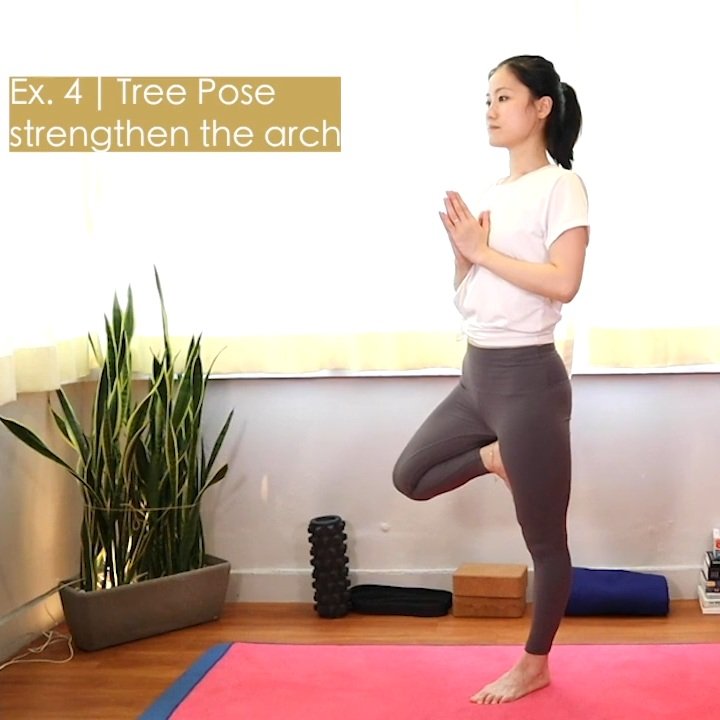
Feet Exercise 4 - Tree Pose (Vrksasana)
Learn to balance with one leg in Tree Pose. Foot stays grounded.
Feet Exercise 5 - Half-Hero Pose Twist
Flexibility is a prerequisite for performing the half-hero pose. If you struggle to sit comfortably in this position or feel excessive strain on your joints, it might be best to avoid attempting this pose.
FeetExercise 6 - Foot Massage
It is recommended to gently massage your foot in a downward and upward motion, ensuring proper care and attention. This beneficial practice can be performed whenever you experience discomfort or require relief from tension in your feet.
FeetExercise 7 - Hero Pose (Vajrasana)
Seated meditation practitioners often find the hero pose to be highly advantageous. By elevating your seat using a cushion or blocks, you can effectively reduce tension in your joints. However, if you find that the pain persists, it is advisable to refrain from practising this pose.
Feet Exercise 8 - Wind down
To conclude your practice, it is advisable to choose a pose that you find relaxing, such as the Seated Forward Bend (Paschimottanasana).
It is important to avoid rushing through the end of your yoga session and instead focus on cultivating a sense of calm until the very end.
More Yoga Asana Articles
Stretch and Touch your Toes with Seated Forward Bend (Paschimottanasana)
Seated Forward Bend or Seated Forward Fold - known as Paschimottanasana in Sanskrit, meaning "back stretching pose", is one of the major hatha yoga postures almost everyone knows. In this asana, the back of the whole body is given an intense stretch, hence the name.
What you need to know- Seated Forward Bend (Paschimottanasana)
Seated Forward Bend or Seated Forward Fold - known as Paschimottanasana in Sanskrit, meaning "back stretching pose", is one of the major hatha yoga postures almost everyone knows. In this asana, the back of the whole body is given an intense stretch, hence the name.
There are also other names for Seated Forward Bend, including Double Leg Forward Stretch, West (Back) Stretch, Ugrasana, Brahmacharyasana etc.
The Hatha Yoga Pradipika describes, "Stretching the legs (in front) on the ground, like a stick; bending forward, holding the toes with both hands and placing the forehead on the knees, is called paschimottanasana."
How to practice Seated Forward Bend (Paschimottanasana)?
Follow the step by step guide below and the YouTube video to achieve your Paschimottanasana safely and gradually.
Step by Step Paschimottanasana
Step 1 To begin the practice, start with Staff Pose. Keep the leg straight and spine erect. To ease the pressure on the lower back and help sit erect easier, you may put a blanket or pillow under the sitting bone.
Step 2 Stretch both arms over the head, elongate the spine, imagine you are reaching your hands as high as possible.
Step 3 Bend forward from the hips, reach forward toward the direction of your feet without hunching your back.
Try modification with the yoga strap to help you align with the pose.
Final Pose Graphic Demonstration Always keep it with you when you practice.
Seated Forward Bend (Paschimottanasana) Guided Sequence
9 Benefits and effects of Seated Forward Bend (Paschimottanasana)
Paschimottamasama is an asana with a calming effect. Numerous benefits when practising the forward bend correctly with mindful consciousness,
Paschimottanasana gives a complete stretch to the whole posterior of the body - to the hips, spine, and muscles of the back and legs.
Image and copyright from Yoga Anatomy by Leslie Kaminoff
Gives a complete stretch to the whole posterior of the body - to the hips, spine, and muscles of the back and legs.
Strengthen and stretches the hamstring muscle.
Increase flexibility in the hip joints.
Tones and massages the entire abdominal organs.
Stimulate and tones the digestive organs.
Increase elasticity in the lumbar spine.
Relieves compression of the spine.
Enhance concentration.
Invigorate the mind and nervous system.
Common Problems of Practicing Seated Forward Bend (Paschimottanasana)
The back is rounded, and the head is down toward the knees.
The feet are apart and the toes are rotated outward.
Feet are not flexed.
Forceful attempting into the pose instead of gently developing the yoga pose.
Counter Pose of Seated Forward Bend (Paschimottanasana)
The Seated Forward Bend is best to counter with Reclining Bound Angle Pose, Locust Pose. Some backward bends are also beneficial for intermediate to advance practitioners, such as Chakrasana (Wheel Pose), Bhujangasana (Cobra Pose) or Matsyasana (Fish Pose).
Disclaimer: Content on this website is for informational purposes only and does not contain medical advice. Please contact your physician or qualified healthcare provider with any questions regarding your medical conditions.
40mins Hatha Yoga Sequence - Full Body Routine for beginner and intermediate level
"Ha" means 'sun' and "Tha" means 'moon.' This is symbolic of the twin energy forces which exist in everything. The main objective of Hathayoga is to create an absolute balance of the interacting activities and processes of the physical body, mind and energy. [1] With regular practice, one can discipline the mind through disciplining the body.
Meaning of Hatha Yoga In Brief
"Ha" means 'sun' and "Tha" means 'moon.' This is symbolic of the twin energy forces which exist in everything. The main objective of Hathayoga is to create an absolute balance of the interacting activities and processes of the physical body, mind and energy. [1] With regular practice, one can discipline the mind through disciplining the body.
Hatha Yoga Full Body Mix Level (Beginner to Intermediate)
In this short 30mins #HathaYoga sequence, we take the totality approach with breathing, meditation, and asanas practice to provide you with a full body-mind awakening in one go. Starting with mind-centring #meditation to reconnect the mind and body, next leading into full-body #Asanas from beginner level to intermediate level, and eventually finish with a relaxing #YogaNidra. Full yoga practice is all you need in a day!
Scroll Down for Yoga Pose List
Yoga Pose Sequence List - Name in English & Sanskrit
Hatha Yoga Sequence Full Body Routine Beginner and Intermediate | CLICK the image to download
Here's is the list of significant yoga poses (a.k.a. asana) from the sequence. Give yourself a challenge, can you map them with the pose? And if you do, how many of them do you also know the name in Sanskrit?
Keep the list with you, enjoy your yoga study and practice.
All-Fours Asana
Table Top Pose - Bharmanasana
Tiger Pose and variations - Vyaghrasana
Standing Asana
Chair Pose - Utkatasana
Humble Warrior - Baddha Virabhadrasana
Intense Side Stretch - Parsvottanasana
Downward Facing Dog - Adho Mukha Svanasana
Backbend Asana
Half Frog Stretch - Half Frog Pose
Bow Pose - Dhanurasana
Core Practice
Boat Pose - Navasana
Forward Bend Stretching
Forward Bends Sage - Marichyasana
Head On Knee Pose - Janu Sirsasana
Seated Forward Bend - Paschimottanasana
Butterfly Pose: Steps, Techniques and Benefits
The Yoga Butterfly Pose or the Bound Angle Pose, known as बद्धकोणासन (Baddha Koṇāsana) in Sanskrit, is a familiar hip opening pose in yoga practice.
In Sanskrit, Baddha means grasping and limiting; Kona means angle (degree); and Asana means posture or action. The butterfly pose also has an interesting name: the Cobbler Pose. In India, shoemakers sit on the roadside in the butterfly pose to mend their shoes, hence the name.
Butterfly Pose is an easy-to-learn movement, perfect for beginners. Though the movement is simple, it has tremendous physical benefits both for men and women. This article will introduce its techniques and benefits.
Introduction of Butterfly Pose (Koṇāsana):
The Yoga Butterfly Pose or the Bound Angle Pose, known as बद्धकोणासन (Baddha Koṇāsana) in Sanskrit, is a familiar hip opening pose in yoga practice.
In Sanskrit, Baddha means grasping and limiting; Kona means angle (degree); and Asana means posture or action. The butterfly pose also has an interesting name: the Cobbler Pose. In India, shoemakers sit on the roadside in the butterfly pose to mend their shoes, hence the name.
Butterfly Pose is an easy-to-learn movement, perfect for beginners. Though the movement is simple, it has tremendous physical benefits both for men and women. This article will introduce its techniques and benefits.
Butterfly Pose or the Bound Angle Pose, known as बद्धकोणासन (Baddha Koṇāsana) in Sanskrit
Butterfly Pose Steps, Methods and Techniques
In steps 1 to 4, you learn to set up the pose and prepare the body for a deeper stretch.
Step (1)
Start by sitting up. Open your legs and bend your knees. Place the soles of your feet against each other.
Step (2)
Grasp your feet with both hands, keeping your back straight and your heels closer to your perineum without straining your knees and hips.
Step (3) - Butterfly Pose Warm Up
Gently move your knees up and down for about 1-3 minutes as a warm-up to help relieve tightness in your waist and hips.
Step (4) - Take A Short Break
After warming up, you can straighten your feet and relax.
In steps 5 to 10, you learn to get deeper into the pose and exit the pose.
Step (5)
Bend your knees again, place the soles of your feet against each other, getting ready for the butterfly pose stretch.
Step (6) - Getting Deeper Into The Pose
Inhale, straighten your back.
Exhale, bend your body forward.
Inhale, lengthen the back again while folding forward.
Exhale and sink a little bit deeper without rounding your back. Place your elbows on your thighs.
Step (7) - Stay In The Pose.
Keep adjusting the pose with deep inhalation and exhalation. Stay for about 5-10 breaths without straining any part of the body.
Step (8) - Exiting the pose.
When completing the movement, inhale, rise, and slowly sit up straight. Then, exhale completely.
Step (9)
Release your legs and shake them to regenerate their circulation.
Step (10) - Counter Pose
For counter pose, you can consider any gentle yoga pose, such as standing movements, forward bending, or twisting.
The Simplified Version Of Butterfly Pose
If you cannot bend forward completely, you can straighten your hands, place your forehead on the yoga blocks, relax and stay in the final pose.
The Anatomy behind Butterfly Pose
Benefits Of Practising Butterfly Pose
The Butterfly Pose has many benefits and can benefit both male and female practitioners. According to the Light of Yoga by B.K.S Iyengar, here are some benefits.
General Benefits of Butterfly Pose:
Suitable for people suffering from urinary disorders to relieve discomfort;
It may stimulate the pelvis, abdomen and back during stretching and enhance blood circulation;
Butterfly pose may relieve sciatic pain and prevent hernia.
Benefits Of Practising Butterfly Pose For Women:
Regulate menstrual cycle. The effect will be even greater when combined with the shoulder stand (Salamba Sarvangasana).
Pregnant women practising butterfly poses daily may help reduce labour pain and prevent varicose veins.
Benefits Of Practising Butterfly Pose For Men:
Regular practice may help keep the kidneys, prostate and bladder healthy;
Relieve testicular pain and heaviness;
An interesting saying suggests that Indian shoemakers rarely suffer from urinary tract problems, presumably because they work in the butterfly posture all day.
Conclusion
In conclusion, the Butterfly Pose, also known as Baddha Koṇāsana, offers a range of physical benefits for both men and women. Its gentle hip-opening stretches make it suitable for beginners, and its potential to stimulate blood circulation and relieve discomfort makes it a valuable addition to any yoga practice. Whether you are seeking relief from sciatic pain, aiming to regulate your menstrual cycle, or looking to enhance the health of your kidneys and prostate, the Butterfly Pose offers a range of benefits worth exploring. Incorporating this pose into your routine can promote physical well-being and harmony.